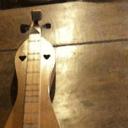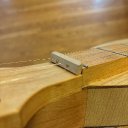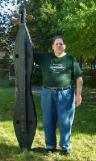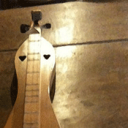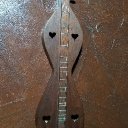
Cherry Jethro Amburgey-style dulcimore
Instruments- discuss specific features, luthiers, instrument problems & questions
Very nice, Great technique on the wood.
Very nice, Great technique on the wood.
if you were to tighten those screws, would the nut be upright and flush with the end of the fingerboard? It seems to be leaning pretty dramatically toward the zero fret and the screws look pretty loose. Maybe is just needs to be re-secured
Just a thought.Dulcimer players are a minority in North America which has an advantage re mainstream media...we can be as creative as we want to be...no pressure to be successful or conform to a certain standard or style, because we're mostly ignored.Very creative situation...Nevertheless,as musicians we need communication,a response.If you like something or a certain approach in a tune or wonder about the technique-ask,like,comment.It's not Spotify...it's a bunch of individuals whatever the playing level doing something they love...Ask,like,comment.
Is that "nut" screwed into the fretboard?? Thats a.....creative.....solution.....
I think it would be simpler to replace the string spacer bar than to replace the tuners. Theoretically, if the spacer bar is lower than the 0 fret, it shouldn't matter that the tuners are higher than the spacer. The only challenge is anchoring the spacer to the headstock well enough that force from the strings doesnt lift the spacer up.
Lots of options for that, good luck!
Nate
FWIW, I tabbed out the basic melody with chords in Em. But it is hard to capture that free and open feeling of the guitar version because in Em, we can't use that many open strings.
When I get some time, I'm going to revisit the tune and arrange it with a capo at the first fret, which will allow more open strings. I might also try to transpose it to Bm.
If you're interested in the tab I created so far, sent me a personal message with your email.
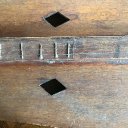
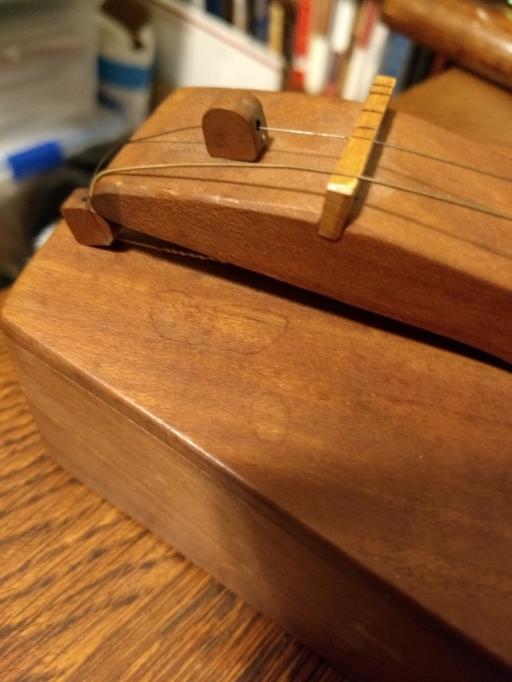
I was gifted a dulcimer recently, and it's got me interested in learning this instrument. However, upon looking at this particular model, it's got some... quirks. In turn, I have questions. The label inside says it was made by a fellow named Walt Kirby out of Oklahoma City. I think he is no longer living (based on a quick google search). Anyway, it's a travel-size, teardrop dulcimer that in many ways seems solidly constructed. However, the string angle coming off the headstock needs addressing. Seems ol' Walt, or some subsequent owner, tried to remedy it by making strange use of a wooden nut. See the pics attached.
As you can imagine, this affects the instrument's ability to hold tune. I'm looking for advice on how to address this. Is it as simple as swapping the tuning machines out for low-post versions? Or, does it need more drastic attention? Ideally, I'd like to be able to put a different nut on that guides the strings, but sits lower than the zero fret. I'm open to ideas.
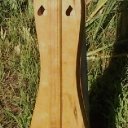
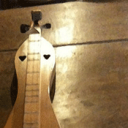
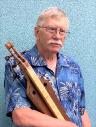
Just completed another Amburgey dulcimer/dulcimore for Greg here in Michigan!
Here's a link of a close up of his finger work. I hope someday I can get my fingers to work like that.
Oh yes thanks Dusty for the Info
I believe that's an "h" at the end of the first word rather than an "n." According to The Session, it is an alternate title to Terry Teehan's . If that's the same tune, the sheet music is offered in Em, but there is no C natural, so it would be playable in that key on the dulcimer.
The Stephen Wake arrangement is very pretty and makes use of the 6-string DADGAD tuning very well. It would be hard to re-create that fluid and open feel on a 3-string dulcimer. I may try to tab this out, but it will be a while before I could get a really nice arrangement.
Hello again kids, how's everybody out there in cyberspace? I hope everybody has survived. all of those fireworks. My dog went completely nuts. But that's not why I'm writing, I just stumbled across the song Deireadn Fomhair that I love. I'm not quite ready for finger picking and I don't know if there's any dulcimer tablatures out there for this song; it's composed for a guitar. looks like you need pretty Nimble fingers maybe down the road. the name of the song is Deireadh Fomhair played by Stephen Wake tuned to DADGAD. Do you think that there are any dulcimer tab. Out there
I have discovered Ultimate Guitar sonce this request. I use it in conjunction with Songbook Pro to upload lyrics and chords to my tablet. A great resource.
I realize this answer comes very late, but it might help you in the future. I always look for chords on https://www.ultimate-guitar.com/. Here's what I found for We Walk By Faith : https://tabs.ultimate-guitar.com/tab/misc-praise-songs/we-walk-by-faith-chords-1774730
If you are a memeber of UU you will know that a baritone is not a proper ukulele.

Another Devonian era person, eh? I joined that age myself back in June. Welcome, welcome. There are several ways to play the dulcimer, to accommodate a variety of 'issues'. We have a number of UK players here, so you're in good company. If all else fails you can build your own box-shaped dulcimer for just a few quid and a day's worth of minor effort, and at least get started learning while looking for a really nice instrument. That's how I started off fifty years ago -- built one so I could learn to play it...
We know shipping to the UK is really expensive. One thought is to have someone here make you a fretboard, which can then be attached to a dulcimer shaped box over there. The fretboard is the critical part, of course, to making the instrument sound good. A good size fretboard is only about 65x4x2 cm and should not be too expensive to ship.
Do you know about the Nonesuch Dulcimer Club there in the UK? it's been around for dog's years. You might google it and contact them to see if anyone has a dulcimer for sale.
If you go to the Beginner Players Group here, you'll find a PDF of a booklet I wrote years ago called I Just Got A Dulcimer, Now What?, which is an illustrated glossary of dulcimer terms (so we all speak the same jargon) plus answers to many beginner questions about tuning, playing, care and feeding of your dulcimer when you get or make it.
Hi Idle - I'm also UK-based, and an excellent source of Dulcimers in the UK is https://revelsmusic.co.uk/ . But also, lots of the US makers and shops will ship (McSpadden and Folkcraft both do quite quickly)!
Happy playing, all the best.
Rob
Jon, it worked both ways you did it-- I saw it in the first format. And I liked seeing it both times! 
Well, idle, I'm looking forward to your questions. Many folks seem to migrate to the mountain dulcimer when having problems playing other instruments. I am having problems fingering chords on guitar, but don't have a problem with the banjo. Luckily I've been playing mountain dulcimer for the last 50 years and can still play chords on it although my preferred style of playing is with a noter.
Ken
"The dulcimer sings a sweet song."
I don't know what didn't work, but I like the drawing. Always nice to see some FOTMD friends no matter the form, human or drawn characters. Thanks for sharing it, Jon.
Ken
"The dulcimer sings a sweet song."
Hello everyone.
I had intended to lurk in shadows while I gathered information especially as I don't have a Dulcimer - yet but I see that some of you already know I am here so decided to say hello.
I live in Sidmouth Devon and I am 76 going on 24 yet gradually winding down my type of instrument playing as old age and old mountain bike accidents come home to roost. I used to play acoustic guitar but I have problems supporting the necks now with my left arm. My pride and joy D28 also started to set off my tinnitus as did my fiddle and mandolin. Ended up with an octave mandolin and baritone ukulele that I still play. I just sold the OM so itching to buy a Dulcimer and still doing research on which one. Bit of a limited selection here in the UK but I think I have identified one.
I also have a lot of questions that I will post over time.
That's really cool. That would be a really useful thing for me to do on dulcimers I make with eye bolts for tuners, since theyre super finicky to fine tune
@dallas , I do apologize that we have veered a bit off track from your main subject. But your Dubroff dulcimer does have some very nice fine tuning beads! 
@nate , a few years ago, member @dave-d restored a Keith Young dulcimer and posted a photo here of the wooden bead fine tuners Keith used to make. (You can look up his 6 yr old thread) Below is the 'before' photo, showing the remaining two beads- one in place properly and the one on the bass string had crept under tailpiece into the wrong place. From the one good one showing, you can see how they were elegantly made and how they might work. They don't actually need to move all that much in order to hear the audible change in the note due to tension change. When moved all the way to the bridge, it should be pretty much slack and not change the note much at all... when slid towards the tail you can hear the pitch go up more. If you need to change the note more than just a little, you just use the main tuning pegs. These beads are only for very fine adjustments once you are quite close to the note you need.
It 'shouldn't' be hard to slide the bead, and it 'shouldn't' drastically change the break angle. The tuning leeway it gives is usually less than 1/2 half step... fine tuning the note. Well made fine tuning beads are (or should be) a pleasure to use... mostly useful if you have old fashioned (non geared) wooden peg tuners. Of course you need to have a flat fretboard surface between the bridge and the pin or the end of the tail, in order to have a place for them to slide up and down. An inch is not generally quite long enough. I like the beads to have a smooth flattened surface where they slide on the fretboard, so that they neither roll nor dig into the fretboard surface over time such as a spherical bead might do.
Nate, beads fitted properly are easy to move to make very fine adjustments.
I am curious about how that affects the break angle of the string. Is the bead difficult to move, due to the pressure on it, or does it slide easily?
Okay, I think that is what I originally thought ken H meant. So, the strings are always in contact with the bridge, and the beads do not change the VSL for intonation? The beads just redistribute the tension that is past the VSL, to allow small tuning adjustments to the open string?
My Keith Young dulcimer has the wood bead fine tuners as well.
Because the string sits high above the soundboard next to the bridge and very low as the string approaches the tail pins or tail end, when you slide the bead towards or away from the bridge, it raises or lowers the non-vibrating section of the string slightly, thus either increasing string tension or lowering it... which makes the note a tiny bit higher or lower, as much as a half step sometimes. Since the Vibrating String Length is not actually changed, these tuning beads simply change the tension of the string by stretching it tighter (with the bead close to the tail) or allowing it to be at natural tension as if the bead wasn't there (when the bead is slid close to the bridge).
Thanks to both kens and Robin for the explanation. The fact that it also has an installed bridge in front of them made that unintuitive to me. Now that I understand better, that seems like a very clever feature.
Oooh, so are they basically fine adjusters for bridge intonation? Sort of like having a separate floating bridge under each string? Kind of like on an electric guitar bridge?
Yes.
Ken
"The dulcimer sings a sweet song."
Oooh, so are they basically fine adjusters for bridge intonation? Sort of like having a separate floating bridge under each string? Kind of like on an electric guitar bridge?
Walt Martin, of Sunhearth Dulcimers, put fine tuners on his instruments. Rather than using beads he made them out of ebony and they were pyramid shaped. A small hole drilled from one end in a slightly upward direction met another hole drilled from the opposite direction met in the middle so that the string moved over a slight peak inside the tuner. By sliding it forward or backward one could shorten or lengthen the string length. I believe Dwain Wilder continues to off this on his Bear Meadows dulcimers, the successor of Sunhearth.
Ken
"The dulcimer sings a sweet song."
That's really interesting. So is it basically the case that sliding the beads forward and back slightly changes the amount of tension?
If this helps, here is an example of fine tuning beads used on a mountain dulcimer, a Keith Young built model (the instrument leaned against the back of the bench):
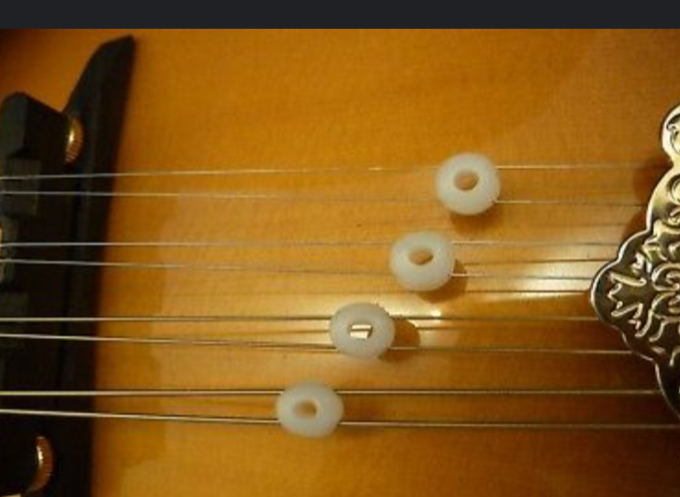
Nate -- what you show ARE dampers for mandolins. But bead type fine tuners are/were common on dulcimers; especially the melody and middle drones -- the most commonly adjusted strings...
Could those beads on the strings be "dampers" similar to the ones on some mandolins and other instruments with a lot of string length past the VSL? Just a thought, I'm not familiar with that sort of fine tuners so I don't really know or understand how they would function.
Good Morning Ken,
Our email address is:
carlondj6@charter.net
Thank you
Nice looking dulcimer. Never heard of John (definitely John) Dubroff, but there there have been thousands of people who built a handful of dulcimers since the 1960s. However -- he appears to have done a nice job on this narrow waisted hourglass design. One interesting thing is that two of the strings have fine tuners -- those light 'beads' or whatever they actually are -- behind the bridge and before the strings bend over the tail piece.
Send me your email address and I'll send you a PDF of my beginner booklet I Just Got A Dulcimer, Now What? It's an illustrated glossary of dulcimer terms (so we all speak the same jargon), plus answers to many beginner questions about tuning, playing, care and feeding of their new instrument.
Hello Everyone,
My mother-in-law gave my wife a dulcimer back in the 1980s. It was built by a man named John (Jolm?) Dubroff of San Francisco in 1972. I'm wondering if anyone has information on this craftsman, the quality of his work, a rough value of the dulcimer, and any other details that might be of interest with regards to said instrument.
My 12-year-old daughter who has dabbled in playing the violin, piano, and double bass is kind of excited about playing something new to her that had been hidden in our closet 😉.
Thanks for your input in advance!
Dallas
John, I don't really do anything that special. I like to mix sweet fruits and berries with tart fruits and berries to balance it out to my own taste. I have a friend who collects wild honey so I use that whenever I get the chance, but usually I like brown sugar, and sometimes settle for white sugar. I leave all the pulp and skin in the mixture, then filter it out after fermentation. I use champagne yeast and a specific gravity gauge to measure the alcohol content and usually stop fermentation at 15% abv. I filter it with cheesecloth and allow the fine particulate pulp to remain, because I believe that a small amount of flesh and skin can decrease hangover symptoms.